David R. Chase, P.A.
Call Us Now: 800-760-0912

David R. Chase, P.A.
Call Us Now: 800-760-0912

CALL TOLL FREE
800-760-0912

SEC Investigation Process Explained in a Flow Chart: From Informal Inquiry to Wells Notice and Litigation

When individuals, executives, investment advisers, broker-dealers, traders, and public companies become the subject of an investigation by the U.S. Securities and Exchange Commission (“SEC”), the consequences can be life-changing.  SEC investigations frequently involve allegations of insider trading, securities fraud, market manipulation, accounting fraud, cryptocurrency violations, investment adviser misconduct, or other violations of the federal securities laws.

Many are simply unfamiliar with how the SEC enforcement process works, what happens after receiving an SEC subpoena, or when an SEC investigation may lead to civil enforcement charges or a referral to the Department of Justice for criminal investigation and, potentially, prosecution.

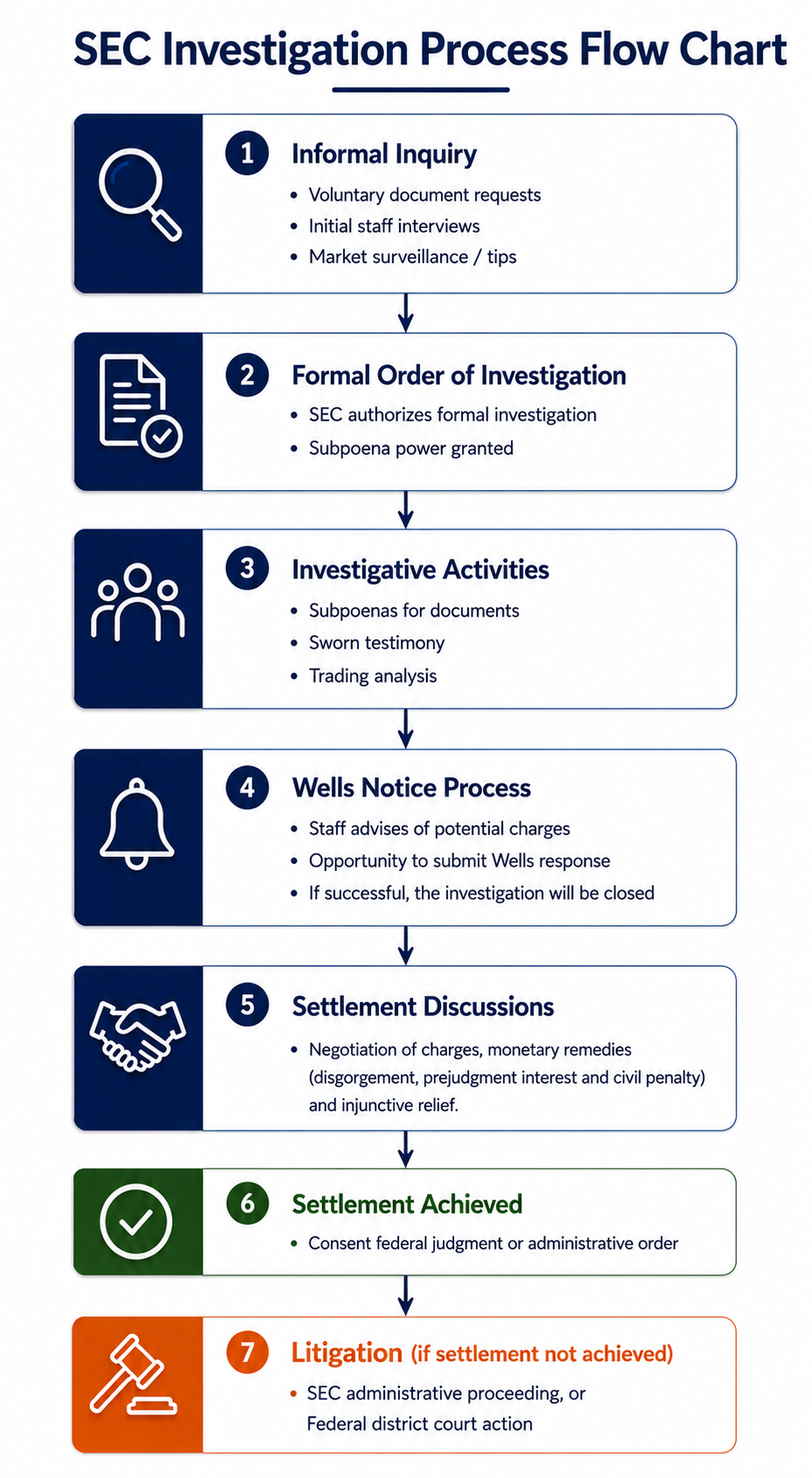
To help clients better understand the SEC enforcement investigatory process, the Law Offices of David R. Chase created the following SEC Investigation Flow Chart outlining the major stages of an SEC investigation — from an informal inquiry through Wells Notice proceedings, settlement negotiations, and SEC litigation.

What Triggers an SEC Investigation?

An SEC investigation may be initiated after:

  • Suspicious trading activity is identified
  • Investor complaints
  • FINRA referrals
  • Whistleblower submissions
  • Public company disclosures
  • Accounting irregularities
  • Market surveillance alerts
  • SEC examinationss
  • Media investigations or short seller reports

In many cases, individuals first learn they are under investigation after receiving an SEC subpoena, SEC document request, SEC testimony subpoena, or notice from the SEC Division of Enforcement, which often takes form in an unannounced telephone call from the SEC staff.

Common SEC investigations include:

  • Insider trading investigations
  • Securities fraud investigations
  • SEC cryptocurrency investigations
  • Ponzi scheme investigations
  • Market manipulation investigations
  • Investment adviser investigations
  • Broker-dealer enforcement actions
  • Accounting fraud investigations
  • Offering fraud investigations
  • SEC whistleblower investigations
SEC Investigation Process
1

Stage 1: SEC Informal Inquiry

Many SEC enforcement matters begin as an SEC informal inquiry. During this phase, SEC Enforcement Staff may request:

  • Voluntary production of documents
  • Trading records
  • Communications and emails
  • Interviews
  • Corporate records
  • Brokerage account information

Although the SEC cannot initially compel testimony during an informal inquiry, the matter should still be treated seriously.  Statements made to the SEC early in the investigation can and will be used against you and may irreparably negatively impact the outcome of the case.

An experienced SEC defense attorney can help clients respond strategically while protecting legal rights and minimizing exposure.

2

Stage 2: SEC Formal Order of Investigation

If the SEC decides to escalate the matter, it may issue a Formal Order of Investigation authorizing SEC Enforcement Staff to issue subpoenas and compel sworn testimony.

At this stage, the SEC may subpoena:

  • Bank records
  • Brokerage account records
  • Trading data
  • Text messages
  • Internal company communications
  • Accounting records
  • Compliance materials
  • Cryptocurrency transaction records

The SEC may also require investigative testimony under oath.

Receiving an SEC subpoena does not necessarily mean enforcement charges will be filed, but it often indicates a more serious, escalated phase of the SEC investigation process.

3

Stage 3: SEC Investigative Activity

During the investigative stage, SEC Enforcement Staff gathers evidence and evaluates potential violations of federal securities laws.

SEC investigations can involve coordination with:

  • FINRA
  • Federal prosecutors
  • State securities regulators
  • International regulators

In certain cases, SEC investigations may proceed simultaneously with criminal securities fraud investigations, often referred to as parallel proceedings.

4

Stage 4: Wells Notice and Wells Submission Process

Before recommending civil enforcement charges, SEC Enforcement Staff may issue a Wells Notice.

A Wells Notice advises the recipient that SEC Staff intends to recommend an SEC enforcement action and provides an opportunity to submit a Wells Submission explaining why charges should not be filed.

A strong Wells Submission, orally or in writing, may include:

  • Legal defenses
  • Factual rebuttals
  • Innocent explanations of trading activity
  • Mitigating circumstances
  • Cooperation and remediation considerations

The Wells Notice process can be a critical stage in defending an SEC investigation. In some matters, persuasive advocacy can prevent charges or reduce the scope of an SEC enforcement action.

In the event a successful Wells Presentation is made, the matter will be closed.

5

Stage 5: SEC Settlement Negotiations

If the SEC cannot be persuaded to drop the proposed charging recommendations, the vast majority of SEC investigations are resolved through negotiated settlement.

Potential settlement terms may include:

  • Cease-and-desist orders
  • Injunctions
  • Civil monetary penalties
  • Disgorgement
  • Prejudgment interest
  • Officer and director bars
  • Industry suspensions
  • Compliance undertakings

Settlement negotiations frequently occur after the Wells Notice stage and may continue through litigation.

An experienced SEC enforcement defense lawyer can help negotiate favorable resolutions while minimizing reputational and financial damage.

6

Stage 6: SEC Litigation and Administrative Proceedings

If settlement negotiations are unsuccessful, the SEC may file:

  • A civil enforcement action in federal district court, or
  • An SEC administrative proceeding

SEC litigation may involve:

  • Discovery
  • Depositions
  • Expert witnesses
  • Motion practice
  • Evidentiary hearings
  • Trial

SEC enforcement actions may seek substantial financial penalties, injunctions, disgorgement, trading suspensions, or industry bars.  Typically, the SEC seeks more significant charges and penalties if the matter is litigated.

In some matters, individuals facing SEC civil charges may also face criminal securities fraud investigations or parallel DOJ prosecutions.

Why Hiring an Experienced SEC Defense Attorney Early Matters

The early hiring of an experienced SEC defense lawyer can significantly impact the outcome of an SEC investigation.

An SEC defense lawyer may help clients:

  • Respond to SEC subpoenas
  • Prepare for SEC testimony
  • Protect Fifth Amendment rights
  • Manage document productions
  • Conduct internal investigations
  • Communicate with SEC Enforcement Staff
  • Prepare Wells Submissions
  • Negotiate SEC settlements
  • Defend SEC litigation

Individuals and businesses facing SEC scrutiny should seek experienced legal representation as early as possible.

Contact an SEC Defense Attorney

The Law Offices of David R. Chase, headed by a former Senior Counsel in the SEC’s Enforcement Division and Special Assistant U.S. Attorney, represents clients in:

  • SEC investigations
  • DOJ securities fraud investigations
  • Insider trading defense
  • Securities fraud defense
  • SEC subpoena response
  • Wells Notice defense
  • FINRA investigations
  • Investment adviser enforcement matters

If you have received an SEC subpoena, Wells Notice, testimony subpoena, FINRA inquiry, or notice of a securities investigation, prompt legal representation is absolutely critical to protecting your rights, reputation, and business.  Call now for a free and confidential consultation: 800-760-0912 or email David at: david@davidchaselaw.com.