Call for a Confidential Consultation
800-760-0912

Insider Trading Defense

Strategic SEC and Federal Criminal Defense for Executives, Traders, Investment Professionals, and Individuals Facing Insider Trading Investigations Nationwide.

Call Us Now: 800-760-0912

Insider Trading Defense Hub

Your Central Resource for Insider Trading Defense News, Legal Strategies, SEC Enforcement Updates, and Federal Defense Insights.

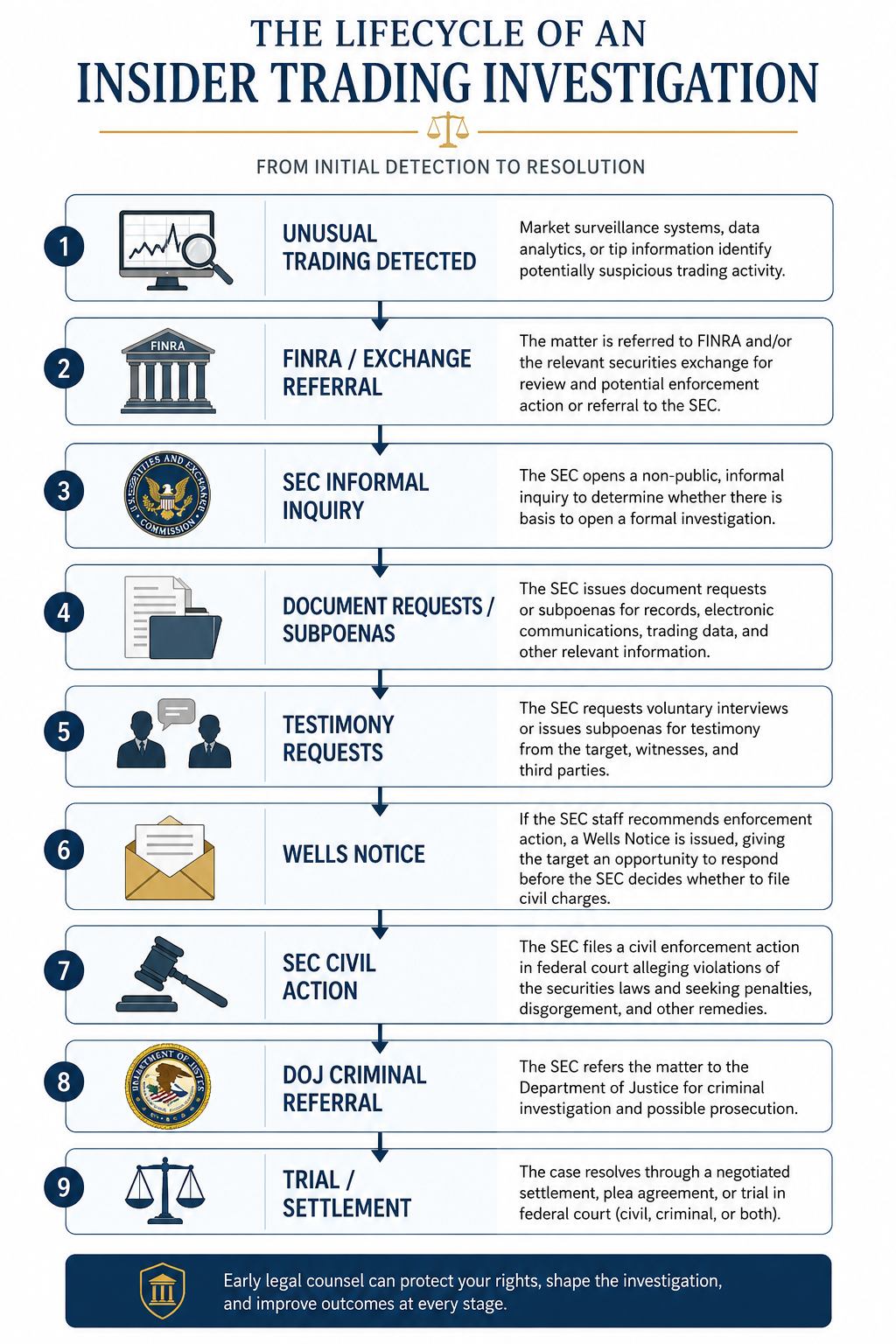
Insider trading investigations are among the most complex and high stakes matters pursued by the SEC and the Department of Justice. What may begin as unusual trading activity flagged by market surveillance systems can quickly escalate into subpoenas, testimony requests, parallel criminal investigations, and allegations carrying severe financial, professional, and even criminal consequences. Individuals under investigation are often confronted with rapidly evolving legal issues involving trading records, electronic communications, confidential information, and federal securities laws.

This Insider Trading Defense Hub was created to serve as a comprehensive resource for individuals, executives, traders, investment professionals, and companies seeking information about insider trading investigations, SEC enforcement actions, and available defense strategies. Throughout this hub, you will find detailed articles, legal analysis, FAQs, enforcement trends, and insights from former SEC prosecutor David R. Chase regarding how insider trading cases are investigated, defended, negotiated, and litigated.

Whether you are responding to an SEC subpoena, evaluating a Wells Notice, or seeking to better understand your rights and potential defenses, this resource center is designed to provide valuable guidance at every stage of the investigation process.

Contact David R. Chase, P.A.

Call Us Now: 800-760-0912

Insider Trading Defense

What must the government prove in an insider trading case?

The SEC needs to prove that an individual traded while in possession of what is called material nonpublic information, meaning an inside tip that was derived from a breach of a fiduciary duty by another.Alternatively, the SEC needs to prove that an individual lawfully came into possession of material nonpublic information—for example, a consultant to a company who is given access to that information for work purposes—but then misappropriated or misused it to trade for personal benefit.It is a lot easier said and defined than proven by the SEC.

I investigated insider trading cases when I was at the SEC. They are difficult to prove. As defense counsel, I insist that the government prove its case, or at least make a showing that it can prove its case.

For clients who did not engage in insider trading, I often advise them to speak to the SEC truthfully, look them in the eye and deny the allegations if that denial is true.

In other situations, I will advise my client to assert his Fifth Amendment right under the United States Constitution, which permits him to remain silent.

The United States Supreme Court has made clear that the Fifth Amendment is designed not only to protect the guilty, but is also designed to protect the innocent who have a reasonable fear of prosecution.

Under that reasoning, a client who is concerned that a statement may be misinterpreted or improperly used against him can constitutionally and lawfully remain silent.

What is the effect of that strategically? It requires the SEC to prove its case. It does not allow the SEC to use my client’s words against him. Instead, they need to independently establish by a preponderance of the evidence the elements necessary to prove their case.

SEC Insider Trading Defense Lawyer | Nationwide & South Florida Representation

When your reputation, career, financial future, and freedom are at stake, the attorney you choose matters. David R. Chase, Esq. is a former SEC Division of Enforcement attorney who has devoted his practice to representing individuals and businesses facing SEC investigations and complex securities enforcement matters. 

Charged with Insider Trading

Under SEC Investigation for Insider Trading?

If you have received a subpoena, Wells Notice, trading inquiry, or contact from the SEC or federal prosecutors, early legal intervention can make a critical difference. David R. Chase, P.A. provides experienced defense representation in complex insider trading investigations and enforcement actions nationwide. 

Free Riding Scheme

What are My Legal Defenses to Insider Trading Charges?

Explore the legal strategies and defenses that may be available in SEC and federal insider trading cases, including challenges to materiality, scienter, intent, tipping allegations, and evidentiary issues. Click here to learn more about defending against insider trading charges.

SEC investigation for insider trading

When Does the SEC Typically Refer Insider Trading Cases to the Department of Justice for Criminal Investigation?

Learn when insider trading investigations may escalate from a civil SEC matter to a parallel criminal investigation by the Department of Justice, and why early defense strategy is critical when federal prosecutors become involved. 

Shadow Trading Defense Lawyer

What is Shadow Trading?

Discover how the SEC is expanding insider trading enforcement through its emerging “shadow trading” theory, targeting trades involving economically related companies even when the trader had no direct connection to the company whose stock was traded. 

anti-fraud provision

What Factors Does the SEC Consider in Evaluating an Insider Trading Case?

Learn about the key factors the SEC examines in insider trading investigations, including trading patterns, timing, access to material nonpublic information, communications, intent, and potential personal benefit.

SEC insider trading defense

Frequently Asked Questions About Insider Trading Investigations and Defense

Get answers to common questions about insider trading investigations, SEC subpoenas, trading inquiries, criminal exposure, penalties, compliance issues, and defense strategies. 

Latest Insider Trading Blog Post

SEC v. MacDonald

How the SEC Determines “Profit” in Insider Trading Cases When No Gain is Realized: An Analysis of the MacDonald Case

In the high-stakes arena of insider trading enforcement, a common misconception exists among defendants: “If I didn’t sell the shares or exercise the option contracts,...
Read More

David R. Chase, Esq. Quoted on Insider Trading in the Prediction Markets

David R. Chase, Esq., principal of the Law Firm of David R. Chase, P.A., was recently quoted in a feature article published by Missouri Lawyers...
Read More
Algorithmic Insider Trading

When the SEC Knocks: Defending Against Algorithmic Insider Trading Probes

Few events in life trigger immediate panic like receiving a SEC subpoena or getting an unannounced call from the staff of the SEC’s Market Abuse...
Read More
SEC ARTEMIS System

The SEC’s ARTEMIS System: Why Insider Trading Investigations Are More Sophisticated Than Ever

For decades, insider trading investigations relied heavily on whistleblowers, referrals from regulatory organizations, and obvious patterns of suspicious, red-flag activity.  Today, the landscape has radically...
Read More
1 2 3 12