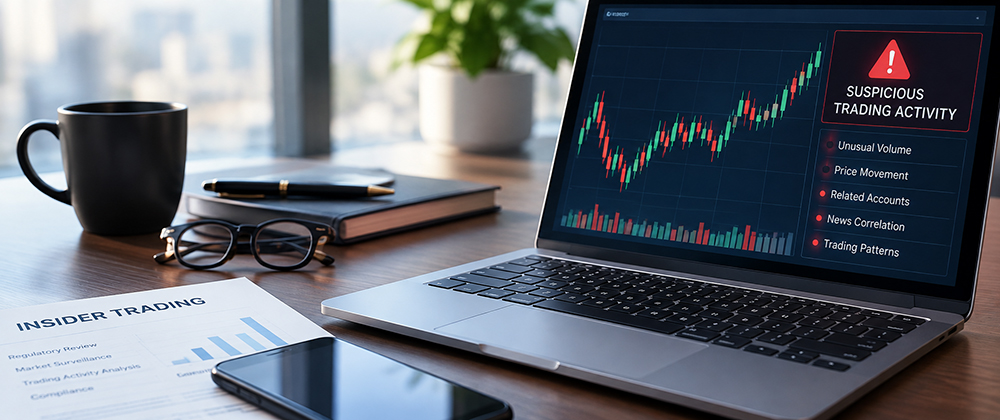
Yes. Artificial intelligence, machine learning, data analytics, and other sophisticated surveillance technologies are increasingly being used to identify potentially suspicious trading activity. However, and critically: an algorithmic alert is not the same as evidentiary proof of illegal insider trading.
The Securities and Exchange Commission (SEC) and the Financial Industry Regulatory Authority (FINRA) have access to enormous amounts of trading and market data. Modern surveillance systems can identify unusual or suspicious trading patterns, compare trading activity with material news events, analyze relationships among traders, and connect trading information with other available data points.
FINRA has publicly stated that its Insider Trading Detection Program uses sophisticated technology and analytics to monitor trading for potentially suspicious activity around material news events, like mergers or acquisitions.
For an investor, corporate executive, employee, broker, or other market participant, this raises an important question:
What happens when a securities regulator’s computer system flags a trade as potentially suspicious?
The answer is a bit complicated.
Key Takeaways
- The SEC and FINRA use sophisticated technology and data analytics to identify potentially illegal insider trading.
- AI can help regulators identify patterns that might otherwise be difficult to detect.
- A suspicious trading alert does not, by itself, establish the evidentiary basis to support the legal elements required to prove insider trading.
- Regulators examine the timing, size, profitability, trading history, communications, relationships, and source of information surrounding a trade.
- A trader can attract regulatory scrutiny even when a trade is made completely lawfully.
- The critical issue in an investigation is not necessarily why a computer flagged the trade, but whether the evidence establishes that the trader possessed and used material nonpublic information.
- If the SEC contacts you about potentially suspicious trading, obtaining experienced securities-enforcement counsel early is essential to protecting your legal and financial interests.
How Does the SEC Detect Potential Insider Trading?
Insider trading investigations traditionally required investigators to identify suspicious trading and then work backward to determine whether the trader possessed material nonpublic information (MNPI).
Technology has turned that process on its head and made it substantially more powerful and effective.
Trading surveillance systems can examine enormous quantities of information and identify relationships that would be otherwise difficult to find manually.
This is particularly important because a suspicious trade may not look suspicious when viewed in isolation. However, a sophisticated surveillance system can compare the transaction against trading history, market activity, corporate events, and other information.
For a more detailed discussion of how this process works, see David Chase’s prior article, The SEC’s ARTEMIS System: Why Insider Trading Investigations Are More Sophisticated Than Ever.
The SEC can also receive referrals and information from FINRA, exchanges, broker-dealers, companies, whistleblowers, other regulators, and law enforcement agencies.
The result is an enforcement environment in which unusual trading activity can be identified much faster, more efficiently, and with more depth of insight than it could have been years ago.
Does the SEC Use Artificial Intelligence to Detect Insider Trading?
Yes. Regulators are increasingly using AI-related technologies and advanced analytics in securities surveillance.
FINRA has specifically discussed the use of AI technology in securities industry surveillance. Such technology can analyze structured and unstructured data and identify patterns and anomalies that may warrant additional investigative scrutiny.
AI and advanced analytics can therefore function as a powerful detection and triage mechanism.
A computer may identify a pattern that deserves human attention. Investigators and attorneys then determine what that pattern means and whether the evidence supports an insider trading charge.
What Trading Patterns Can Trigger an Insider-Trading Alert?
There is no single trading pattern that automatically establishes insider trading.
Instead, regulators may consider multiple circumstances surrounding a transaction. Examples can include:
- A purchase or sale of a stock shortly before a significant corporate announcement.
- An unusually large position relative to the trader’s normal trading activity.
- A sudden change in a person’s historical trading pattern, including the purchase of short-term options for the first time.
- Trading shortly before a merger, acquisition, earnings announcement, regulatory decision, or other material event.
- Options activity that produces an unusually large profit following a corporate announcement, particularly if the options are significantly out-of-the-money.
- Trading by individuals connected to company insiders.
- Trading in multiple accounts that appear to be related.
- Trading in a third-party account that has no apparent relationship to the trader.
- Communications or other evidence suggesting that information may have been shared.
- A pattern of profitable trades preceding multiple material announcements.
Importantly, none of these circumstances alone necessarily proves insider trading, but in combination, they may increase the chances that a trade is flagged and investigated.
There are many legitimate reasons why a person might buy or sell a security shortly before an announcement. The investigation is therefore often about putting the trading activity into context.
Why an Algorithmic Alert Does Not Mean Someone Committed Insider Trading
This is one of the most important concepts for anyone facing an SEC insider trading investigation.
An algorithm is designed to find unusual patterns. That is different from determining whether a securities-law violation occurred.
Consider a hypothetical example:
An individual sells a substantial number of a company’s shares three days before an unexpected acquisition announcement. A surveillance system flags the transaction because the timing, size, and subsequent price movement are unusual.
That may cause regulators to ask questions. But there could be an innocent explanation for the trade that is wholly inconsistent with illegal insider trading.
That is where human investigation begins.
What Happens After a Suspicious Trade Is Flagged?
An alert is the beginning of an investigation, not the conclusion. Regulators may seek to understand:
- Who traded?
- When did the person trade?
- How much did the person trade relative to their liquid net worth?
- What was the person’s historical trading pattern?
- What happened to the security afterward?
- What information was available to the trader?
- Did the trader have a relationship with someone who possessed material nonpublic information?
- Were there communications between the trader and company insiders?
- Did the trader communicate with other potential participants who possessed MNPI?
- Was the trading part of a pre-existing plan or investment strategy?
- Were there other accounts or individuals involved?
- What plausible, legitimate explanation exists for the transaction?
In other words, the SEC wants to know: “What did this person know, when did the person know it, and how did the person obtain that information?”
What Evidence Does the SEC Look At in an Insider-Trading Investigation?
Trading data is only one piece of the puzzle. Depending on the circumstances, investigators will analyze:
- Brokerage records
- Trading-account information
- Emails
- Text messages
- Telephone records
- Internal company communications
- Calendar records
- Corporate documents
- Deal documents
- Earnings information
- Meeting records
- Relationships among traders and corporate insiders
- Information concerning the source and timing of material information
David Chase discusses this investigative process in greater detail in Former SEC Prosecutor Explains: What Really Happens During an SEC Insider Trading Investigation.
Can an Innocent Trade Trigger an SEC Investigation?
Yes.
That possibility is particularly important in an era of increasingly sophisticated surveillance.
The purpose of surveillance is to identify activity that warrants further review. A system that generates an alert does not necessarily know whether the underlying conduct was lawful.
For example, a person who routinely invests in a particular industry could coincidentally make a profitable investment shortly before a company announces an unexpected development.
From the perspective of a surveillance system, the transaction may look unusual. From the perspective of the investor, it may be completely ordinary and entirely consistent with their prior trading history.
The investor may nevertheless receive an SEC Subpoena and have to explain the circumstances. David Chase discusses this investigative process in greater detail in Received an SEC Subpoena? How to Choose the Right SEC Defense Lawyer.
That is why maintaining accurate records and preserving contemporaneous evidence can become extremely important.
What Role Does FINRA Play?
FINRA plays a significant role in identifying potentially suspicious trading activity.
Its Insider Trading Detection Program uses technology and analytics to identify potentially suspicious activity surrounding material news events.
FINRA can and often does refer matters to the SEC for investigation.
For registered representatives, broker-dealers, and other FINRA-regulated entities, the regulatory issues can therefore extend beyond an SEC investigation.
Does AI Make Insider-Trading Investigations More Dangerous for Investors?
Yes.
The principal change is not necessarily that regulators have replaced investigators with computers.
Instead, technology allows investigators to identify potential relationships and patterns on a scale that previously was not possible. That means a trading pattern that might once have escaped attention can now potentially be identified.
What Is a Rule 10b5-1 Trading Plan?
It is a prearranged, written contract between a corporate insider and a securities broker that establishes predetermined instructions for buying or selling stock.
Can a Rule 10b5-1 Plan Be an Affirmative Defense to an Insider Trading Investigation?
Yes. A properly structured and appropriately administered trading plan may provide an affirmative defense to insider-trading liability when its requirements are satisfied.
It does so because it allows the trader to argue that the trade was predetermined and thus not based upon MNPI.
But the existence of a purported trading plan does not necessarily end every SEC inquiry. Regulators will probe as to:
- When the plan was adopted
- Whether the trader possessed material nonpublic information at the relevant time
- Whether the plan was modified or terminated shortly before the trade, and the circumstances surrounding the modification or termination
- Whether the plan was followed
- Whether the arrangement satisfies applicable requirements
Anyone relying on a Rule 10b5-1 plan should therefore not assume that the mere existence of the plan makes them immune to government scrutiny.
What Should You Do If the SEC Contacts You About a Suspicious Trade?
Do not assume that the matter will disappear simply because you believe the trade was innocent.
And do not assume that an informal request from an SEC attorney is insignificant.
And do not assume you can simply explain it to the SEC, and it will end the investigation.
If you receive an SEC subpoena, inquiry, interview request, or other communication concerning potentially suspicious trading, consider taking several immediate steps:
- Preserve relevant information: Do not delete emails, texts, documents, trading records, or other potentially relevant information. Preservation should generally extend beyond the particular trade that prompted the inquiry.
- Do not try to reconstruct events from memory if records exist: A contemporaneous document may be far more reliable than a recollection formed months or years later.
- Avoid casually explaining the trade before understanding the investigation: In decades of defense experience, a seemingly harmless explanation can create inconsistencies if it is incomplete or inaccurate, or can potentially be viewed as untruthful and thus obstructive.
- Understand what the SEC is actually investigating: The initial inquiry may involve one transaction but ultimately concern a broader set of trades, communications, or relationships.
- Retain counsel deeply experienced in SEC enforcement matters: An attorney familiar with SEC investigations can help determine what the investigators are seeking, preserve relevant evidence, evaluate potential defenses, and manage communications with regulators.
For additional discussion of the practical mistakes that can complicate an SEC investigation, see 5 Critical Mistakes That Can Make an SEC Investigation Worse.
What Does the SEC Need to Prove in an Insider-Trading Case?
An algorithmic alert is only the beginning. Ultimately, the SEC must establish the legal elements of its insider-trading theory with admissible evidence.
That is why watching the video, What Does the SEC Need to Prove to Win an Insider Trading Case?, in the Law Firm of David R. Chase Video Library is recommended.
The central issue is not simply whether a trade was profitable or well-timed. The SEC must connect the trading activity to the required elements of an insider-trading violation.
For someone facing an investigation, understanding that distinction can be critical.
The Bottom Line
The SEC and FINRA have powerful technological tools for identifying potentially suspicious trading.
These tools can help regulators find patterns across enormous quantities of market data and identify transactions that deserve closer examination.
But an algorithmic alert is not proof of insider trading.
A suspicious transaction still requires investigation, context, evidence, and a legally sufficient theory of liability.
The critical questions are what the trader knew, when the trader knew it, how the trader obtained the information, and why the trade was made.
That is where experienced securities-enforcement counsel can make a game-changing difference.
David Chase’s Attorney Profile explains his background as a former Senior Counsel in the SEC’s Enforcement Division and Special Assistant U.S. Attorney. His practice focuses on SEC investigations, with a focus on insider trading defense.
If you are facing an SEC investigation or have received an SEC subpoena concerning potentially suspicious trading, you can learn more about the SEC defense Law Firm of David R. Chase and its SEC defense practice.
Frequently Asked Questions
- Does the SEC use AI to detect insider trading?
The SEC and other securities regulators use sophisticated technology, data analytics, and increasingly AI-related tools to identify patterns and anomalies that may indicate potential securities-law violations.
- Does FINRA monitor every trade?
FINRA has stated that its Insider Trading Detection Program monitors trading in stocks, options, and bonds for potentially suspicious activity surrounding material news events.
- Does an SEC algorithmic alert mean I committed insider trading?
No. An alert identifies activity that may warrant additional investigation. It does not by itself establish that the trader possessed material nonpublic information or violated federal securities laws.
- What can trigger an insider-trading investigation?
Potential triggers can include unusual trading before material announcements, significant deviations from historical trading patterns, relationships with corporate insiders, suspicious communications, unusually profitable transactions, and other circumstances suggesting possible access to material nonpublic information.
- Can a 10b5-1 plan protect me from an insider-trading investigation?
A properly structured Rule 10b5-1 trading plan may provide an affirmative defense when applicable requirements are satisfied. However, regulators may still examine the circumstances surrounding the plan and its use.
- What should I do if the SEC contacts me about a trade?
Preserve relevant documents and communications and consider consulting experienced securities-enforcement counsel before responding to substantive questions or agreeing to an interview.
About David R. Chase: SEC defense attorney David R. Chase is a former SEC Enforcement attorney who represents individuals, executives, companies, and financial professionals in SEC investigations nationwide, including all major financial hubs: Miami, Chicago, Austin, New York City, New Jersey, San Diego, San Francisco, Los Angeles, Houston and Atlanta.